
The Delayed Start: Why So Many Young Adults Feel Stuck Financially
Understanding the financial pressures shaping a generation and what can be done about it
Over the years in my work as a financial coach, I have had the opportunity to sit down with young adults and newly married couples who are trying to build their lives. They are intelligent, hardworking individuals who followed the path they were told would lead to success. They worked hard in school, earned college degrees, and stepped into the workforce expecting to begin building the future they had envisioned.
Yet many of them describe a similar feeling. Despite doing everything they were told to do, life feels delayed.
The milestones they expected to reach in their twenties or early thirties seem further away than they imagined. Buying a home feels out of reach. Paying down student loans feels overwhelming. Saving and investing for the future often feels impossible while simply trying to manage everyday expenses.
Instead of building momentum, many feel as though they are managing pressure.
This is not the result of one single problem. Rather, it is the product of several powerful forces that have come together at the same time. Rising housing costs, significant student loan debt, limited financial literacy, and a job market that does not always reward degrees with the salaries people expected have created a challenging starting point for many young adults.
When these factors combine, they create what I often describe as a perfect financial storm.
The Weight of Student Loan Debt
One of the most visible drivers of this shift is the dramatic growth of student loan debt in the United States.
Student loans were originally intended to expand access to higher education and opportunity. In many ways they still serve that purpose. However, the scale of student debt today is unprecedented. Americans now owe more than $1.7 trillion in student loans, making it one of the largest categories of household debt in the country.
For many young adults, this debt begins before their financial lives have even started.
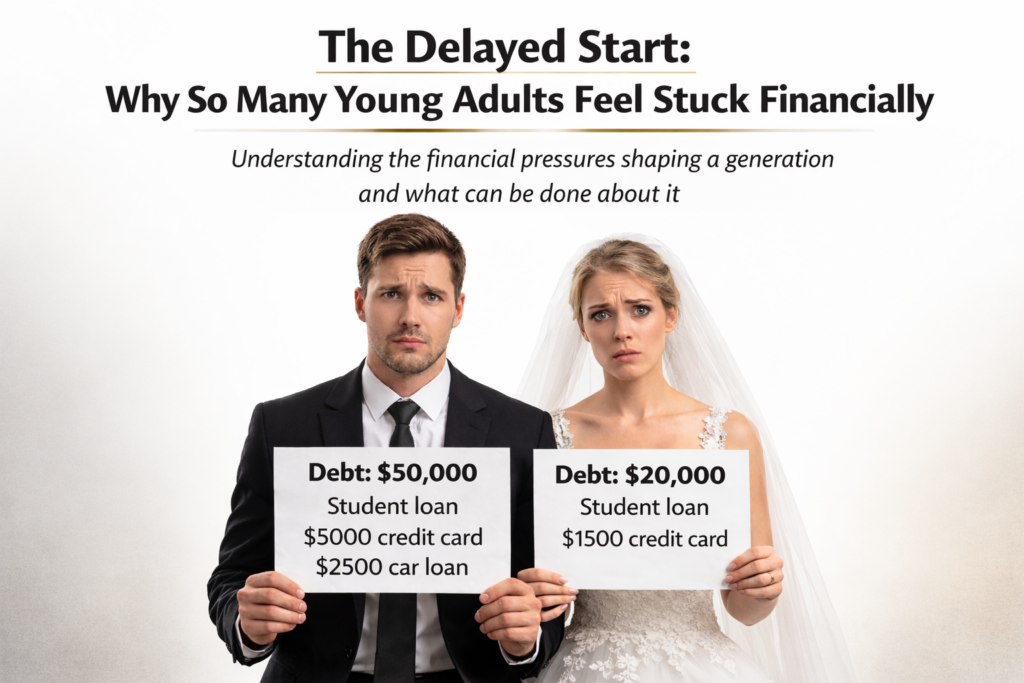
In my coaching work, it is not uncommon to meet couples who enter marriage already carrying significant balances. One spouse may have $50,000 in student loans along with smaller balances on credit cards or a vehicle. The other may bring $20,000 in student loans and some consumer debt as well. Before their financial lives together have truly begun, they may already be facing $70,000 or $80,000 in obligations.
The challenge with this kind of starting point is not simply the balance itself. It is the effect that debt has on financial flexibility. Monthly loan payments reduce the ability to save for a down payment on a home. They slow the process of building an emergency fund. They delay investing for retirement. In some cases, they even influence career decisions, as individuals feel pressure to pursue higher paying roles simply to manage their financial obligations.
Rising Housing Costs and a Delayed Starting Line
At the same time that student loan debt has increased, housing affordability has moved in the opposite direction.
Home prices have risen dramatically across much of the United States over the past two decades, while wages have not kept pace at the same rate. Saving for a down payment has become significantly more difficult, particularly for young adults already managing student loan payments.
Recent data from the National Association of Realtors illustrates just how dramatically this landscape has changed. The median age of first time homebuyers in the United States is now approximately 40 years old, the highest on record.
Only a decade ago, the typical first time buyer was in their early thirties. A generation earlier, it was common for individuals to purchase their first home in their late twenties.
This shift represents more than a statistic. It reflects a change in the timing of life itself. Buying a home later often means building equity later. It may also mean delaying other important milestones such as starting a family or investing aggressively for retirement.
The Cost of Delaying Investing
One of the less obvious consequences of a delayed financial start is the impact it has on long term investing.
The earlier someone begins investing, the more time their money has to grow through compound returns. When investing is delayed by ten or even fifteen years, the difference in long term wealth can be substantial.
Consider a simple example.
If someone begins investing $300 per month at age 22 and continues until age 65, assuming a moderate annual return of 8 percent, they could accumulate approximately:
$1.05 million
However, if that same person delays investing until age 32 and invests the exact same amount each month, their total at age 65 would be approximately:
$440,000
| Starting Age | Monthly Investment | Estimated Value at 65 |
|---|---|---|
| 22 | $300 | ~$1,050,000 |
| 32 | $300 | ~$440,000 |
A ten year delay cuts the final amount by more than half, even though the monthly investment remains the same.
This example illustrates why early financial education is so important. Time is one of the most powerful tools in building wealth, yet many young adults begin investing later simply because they were never taught how important it is to start early.
A Generation Doing What They Were Told, But Without the Playbook
There is another important part of this story that often receives less attention. Many young adults today did exactly what they were told to do. They worked hard in school, earned degrees, and entered the workforce with ambition and determination.
But very few were ever taught how money actually works.
Over the years I have had the opportunity to host financial literacy workshops for high school seniors and young adults. One of the most striking aspects of these conversations is how frequently students express uncertainty about the most basic financial concepts.
Many openly admit that they do not know how credit cards work, how to create a budget, how to invest, or even how to file their taxes.
This is not a reflection of laziness or irresponsibility. It is simply a gap in education. Students graduate with strong academic training in many subjects, yet very little exposure to the practical financial skills that will shape nearly every major decision they make as adults.
The Emotional Cost of Financial Pressure
When student loan debt, rising housing costs, and limited financial education collide, the impact is not only financial. It is emotional as well.
Financial stress has consistently been identified as one of the leading sources of anxiety for American households. For young couples trying to build a life together, this pressure can create uncertainty about the future.
Questions begin to arise about whether they will ever be able to buy a home, start a family, or retire comfortably.
Over time, this uncertainty can chip away at something deeply important. It can diminish hope.
What Every Young Adult Should Learn About Money
While we cannot change the broader economic environment overnight, we can equip young adults with the knowledge and tools they need to navigate it more effectively.
Understanding how to create a budget, manage credit responsibly, build savings, and invest consistently can dramatically change someone’s financial trajectory.
These skills are not complicated, but they are powerful. When young adults gain clarity about how money works, they begin making decisions with greater confidence and intention.
How Financial Coaching Can Help
For many people, the greatest obstacle is not a lack of motivation or discipline. It is simply a lack of guidance.
Financial coaching helps individuals and couples step back from the stress of day to day financial decisions and build a clear plan for their future. Instead of trying to figure everything out alone, they gain a structured path forward.
A financial coach helps people organize their finances, develop a realistic spending plan, eliminate unnecessary debt, build emergency savings, and begin investing with purpose. Just as importantly, coaching helps couples communicate more effectively about money and align their financial decisions with their shared goals and values.
The goal is not perfection. The goal is progress.
When people gain clarity and begin taking small steps forward, those small wins begin to build confidence and momentum.
A Path Forward
While the financial landscape facing young adults today is undeniably challenging, circumstances are not destiny.
Student loan debt, rising housing costs, and uncertain career paths may delay progress, but they do not eliminate the possibility of building a meaningful and financially secure life.
The path forward begins with education, clarity, and a plan. From there it requires discipline, consistency, and patience. Over time, small steps begin to build momentum and restore something that financial stress often steals from people: hope.
Young adults today may face a delayed start, but they are not without opportunity. With the right knowledge and a clear plan, they can still build lives centered around stability, generosity, and purpose.
Dream Big. Live Free.
👉 Book a Free 30-Minute Call
No pressure.
No sales pitch.
Just a conversation.
Just support.
Just the first step toward a stress free, healthy life.
You Can Do This — And You Don’t Have to Do It Alone
No matter where you’re starting today, you can build:
- stability
- confidence
- peace
- unity in your marriage
- a foundation for your kids
- margin for what matters
- room to dream again
And I’ll be right here walking with you, encouraging you, and reminding you that you are capable of more than you think.
Dream Big. Live Free.
About the Author
TJ Recinella (Owner/ Founder of TJR Financial Coaching)

TJ is a financial coach that helps couples who earn good money but feel like they have nothing to show for it. They’re unsure about their financial situation and frustrated that they aren’t where they should be. He provides a path forward and helps them believe in themselves so they can get unstuck, gain confidence, take control and change their financial future.
Let’s chat—book a free call:
.