The Plain, Ugly Truth About Finances
Let’s be honest. The truth about money isn’t pretty. It’s not inspiring. It’s not glamorous. It’s ugly.
Most people are living in a financial illusion—a system designed to keep them comfortable, compliant, and broke.
You probably won’t like what I’m about to tell you. In fact, it may hit close to home and make you sick to your stomach. I hope it does. Because if it doesn’t move you, you’ll keep doing what everyone else does—nothing. And doing nothing is exactly how most people stay trapped in financial chains they never break free from.
We think we’re making financial choices, but most of those choices have already been made for us. From the first credit card offer in college to the “0% for 12 months” ads to the constant “you deserve this” marketing that fills your social feed, we’ve been trained to believe that debt is normal, credit is freedom, and payments are just part of life.
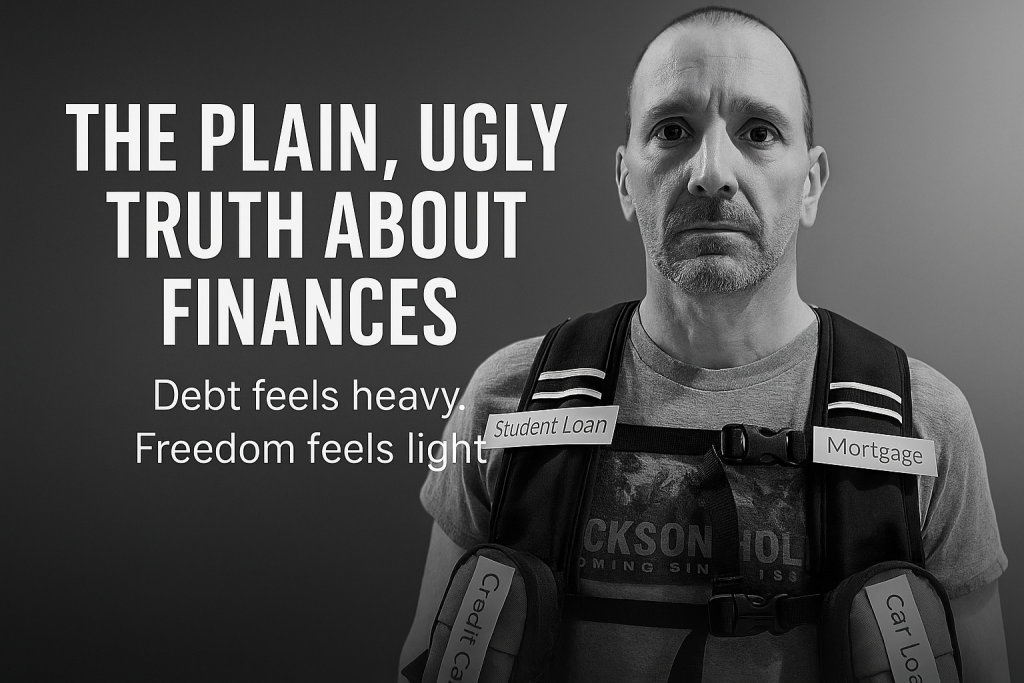
For years, I believed that lie. I worked hard, paid my bills, and told myself, “We’re doing fine.” Then a tragedy in our family forced me to face reality. That moment opened my eyes to the truth: we weren’t in control. Money was.
And here’s what I learned: if you don’t take control of your finances now, life will eventually force you to. Don’t sit there and do nothing. Don’t keep telling yourself you’ll “start later.” Every year you wait, every decade you delay, the road gets harder and the sacrifice steeper.
Fifteen or twenty years from now, you’ll wish you had started today.
And don’t even get me started on the student loan racket. We’ve built a system that chains young adults to decades of payments before they ever get a chance at freedom. Now I’m hearing about 50-year mortgages, as if turning your life into a half-century payment plan is a solution. That’s not financial progress. That’s bondage disguised as opportunity.
Kicking the can down the road doesn’t solve anything. It just makes you broke later—when it hurts more, when retirement is around the corner, when time and health are running out.
This isn’t meant to scare you. It’s meant to wake you up. Because once you see the truth, you can’t unsee it.
1. How We Behave With Money: Upbringing and Life Events
Think about how you were raised around money. Was debt shameful or normal? Were credit cards common? Did your parents talk about money, or was it a topic you avoided?
I grew up in a working-class family. We weren’t rich, but my parents kept things together. I was taught to work hard, sacrifice, and provide. That became my entire money lens.
Then life shattered that lens. In 2005, we lost my wife’s parents in a car accident. Overnight, we became responsible for her sister and had to manage an estate we weren’t prepared for. It wasn’t just about numbers. It was about grief, identity, and responsibility all at once. That experience completely changed how I saw money.
I realized that managing money isn’t just about saving or earning more. It’s about mindset and behavior. It’s about becoming intentional.
“If you don’t address your financial mindset, you’ll keep fighting the same battles no matter how much you earn.”
Your upbringing and your life experiences shape:
- How you talk about money—or if you avoid it
- Whether you believe you can truly be financially free
- Whether you accept debt as normal or fight to eliminate it
- Whether you believe you’ll always be “just getting by”
If you don’t deal with those roots, you’ll keep repeating the same financial patterns.
2. The Marketing Machine
Here’s the truth: banks, credit card companies, and mortgage lenders are not your friends. They’re billion-dollar businesses that depend on you staying in debt.
The Numbers Don’t Lie
- U.S. credit card debt hit more than $1.21 trillion in 2025 — the highest level ever recorded. (Forbes Advisor, 2025)
- The average balance per household is about $7,300. (LendingTree, 2025)
- Almost half of all U.S. households carry credit card debt. (Federal Reserve, 2024)
- The average interest rate is over 21%, the highest in decades. (WalletHub, 2025)
That’s not by accident—it’s a business model.
They lure you in with cash-back rewards and travel points. They make spending frictionless with tap-to-pay and online autofill. They tell you it’s okay to carry a balance. They make it sound responsible.
Debt feels harmless until it becomes a habit. Before you know it, a “normal” life includes car loans, student loans, credit cards, and a mortgage that never goes away.
They don’t want you free. They want you functional. As long as you keep making payments, you’re profitable.
3. How Big Business Keeps You in the Game
The financial industry doesn’t just serve you—it feeds on you.
When you carry debt, you generate income for banks, lenders, and retailers. Every interest payment, every late fee, every refinance keeps the system running.
- Credit card companies earn over $170 billion in profits each year. (IBISWorld, 2025)
- Mortgage lenders make billions through interest and refinancing cycles. (Statista, 2024)
- Auto loan terms now average 69 months for new cars—more interest for them, less flexibility for you. (Experian State of the Automotive Finance Market, 2025)
They’ve made debt look “smart.” They’ve made it sound like “financial strategy.” But the truth is, the more normalized it becomes, the less anyone questions it.
What if you stopped accepting “normal” as your goal?
4. The Emotional and Physical Toll of Debt
Debt doesn’t just drain your bank account—it drains your peace.
The Human Cost
- People with high unsecured debt are 3.5x more likely to experience anxiety or depression. (American Psychological Association, 2024)
- Financial stress raises cortisol, impacting sleep, focus, and blood pressure. (Cleveland Clinic, 2023)
- 42% of U.S. adults say money problems negatively affect their mental health. (Bankrate, 2024)
- Financial stress remains one of the leading causes of divorce. (Ramsey Solutions Study, 2023)
I’ve coached couples who earn great incomes but feel completely broke. The problem isn’t income. It’s control. Debt eats away at your confidence and your relationships. It whispers, “You’ll never get ahead,” until you believe it.
The true cost of debt isn’t the interest—it’s the erosion of peace, hope, and unity.
5. The Breakthrough: Peace and Freedom
Here’s the good news. Once you face the truth, you can change it.
After our family tragedy, my wife and I decided we were done living under the weight of financial pressure. We found a plan, stuck with it, and paid off $300,000 in debt—including our home. We fully funded our kids’ college accounts and began giving generously. We aligned our money with our mission.
That decision changed everything.
We went from stressed to confident, from reactive to intentional. We could say “yes” or “no” based on purpose, not pressure. We stopped chasing income and started chasing impact.
When you eliminate debt, you gain:
- Peace. No more sleepless nights worrying about bills or interest rates.
- Freedom. You make decisions from strength, not fear.
- Clarity. You and your spouse can finally plan together.
- Impact. You can give, serve, and dream boldly again.
The truth will set you free—but only if you believe it.
You need a strong “why.” Your family. Your faith. Your future. And the courage to ignore the noise that says:
“Don’t pay off your house.”
“Keep your car loan.”
“Use credit cards for the rewards.”
I’ve heard it all. But the people giving that advice are still trapped.
Pick your hard. You can stay stressed and in debt, or you can do the hard work to break free. One path leads to exhaustion. The other leads to peace.
6. The Next Step
So, where do you start?
Be honest with yourself. Where are you stuck? Talk with your spouse. What stories about money have shaped your life? Then take one small step today.
✅ Write down every debt you have.
✅ Build your first real budget.
✅ Cancel one expense that isn’t adding value.
✅ Stop telling yourself “later.”
If you want a roadmap, that’s what I do. I walk people through this process because I’ve lived it. I know the peace that comes when you finally take control of your money instead of letting it control you.
You don’t have to stay stuck. You don’t have to follow the crowd. You just have to decide: enough.
The Bottom Line
Finances aren’t just numbers. They’re mindset. They’re emotion. They’re faith.
You’ve been conditioned to believe debt is normal. But normal is broke. Normal is stressed. Normal is miserable.
You can choose better. You can wake up, take control, and build a life of peace and purpose.
Because once you know the truth, the only question left is this:
What are you going to do about it?
🔗 References
Ramsey Solutions – Money and Marriage Studyway.
Forbes Advisor – Average Credit Card Debt Statistics 2025
LendingTree – Credit Card Debt Study 2025
Federal Reserve – Consumer Credit Report
WalletHub – Average Credit Card Interest Rate (2025)
IBISWorld – Credit Card Issuing in the U.S.
Statista – Mortgage Lending Value in the U.S.
Experian – State of the Automotive Finance Market 2025
American Psychological Association – Stress in America 2024: Financial Stress Report
Cleveland Clinic – How Financial Stress Affects the Body
Bankrate – Debt and Mental Health Statistics 2024
Want coaching?
What are you going to do about it? Let’s take that next step together. Schedule a coaching session and start moving forward with purpose. Schedule a free financial coaching session here.
TJ is a financial coach that helps couples who earn good money but feel like they have nothing to show for it. They’re unsure about their financial situation and frustrated that they aren’t where they should be. He provides a path forward and helps them believe in themselves so they can get unstuck, gain confidence, take control and change their financial future.
Let’s chat—book a free call:
About the Author
TJ Recinella (Owner/ Founder of TJR Financial Coaching)

TJ helps couples who earn good money but feel like they have nothing to show for it. They’re unsure about their financial situation and frustrated that they aren’t where they should be. He provides a path to help them get unstuck, gain confidence, and change the financial future of their families.
.